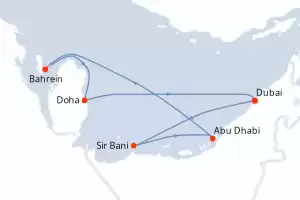
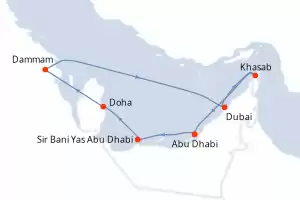
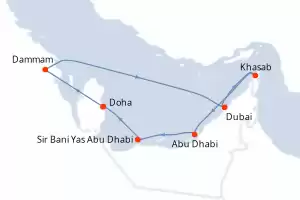
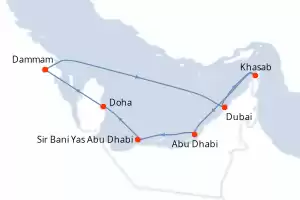
Welcome to the land of petroleum.
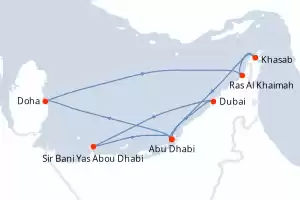
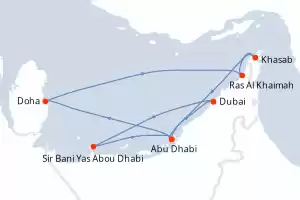
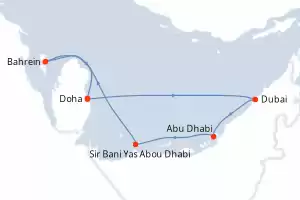
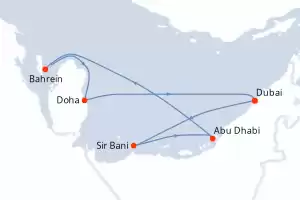
The Middle East encompasses the region between the eastern shore of the Mediterranean and the borders of Pakistan, Iran and Afghanistan. The Middle East is a vast territory covering almost 7,300,000 square kilometers. This makes it the 7th largest geographical area in the world, in terms of surface area. In the popular imagination, the Middle East is far from being a tourist destination. But you'd be wrong. A cruise to the Middle East takes you to peaceful places, far removed from conflict zones. Made up of 98% land, including the desert, and barely 2% waterways, the Middle East seems at first sight to be an inhospitable territory. And yet, during your cruise stopover, you'll see that thanks to the oil windfall, the countries of the region have been able to tame the desert sands to create great metropolises that would make our Western cities green with envy. During your stopovers, you'll be fascinated by the ostentatious luxury that reigns in the cities of the Middle East, reminiscent of the excess and pomp that reigned in the courts of the caliphs and sultans of yore.
A cruise to the temples of excess
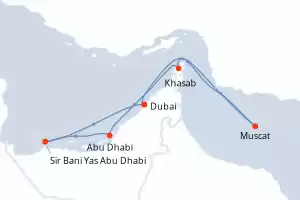
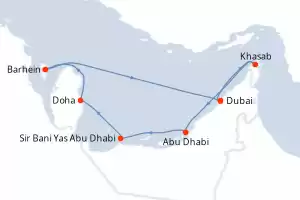
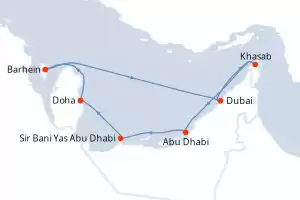
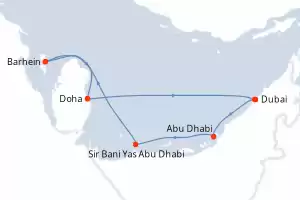
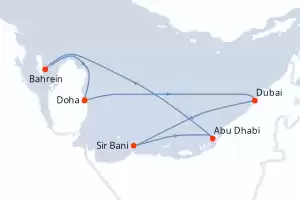
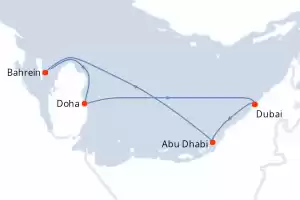
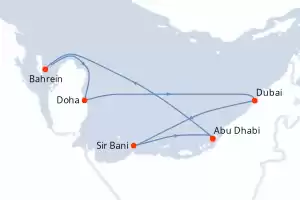
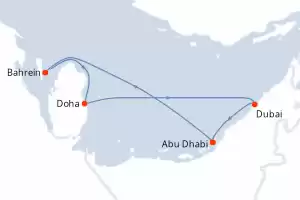
A cruise to the Middle East is always awe-inspiring, especially during a stopover in Dubai. A city where luxury seems commonplace, skyscrapers reach for the sky and souks are adorned with gold and silver. Among Dubai's most spectacular buildings is the Burj al-arab, a sail-shaped artificial island designed by Tom Wright. In Abu Dhabi, the other emblematic city of the United Arab Emirates, modern construction and tradition go hand in hand. The city's finest landmark is the 22,500 m² Sheikh Zayed Mosque, known as the Mosque of Records because it houses the world's largest chandelier and carpet. It took 10 years to complete this architectural masterpiece, in which marble takes pride of place. A cruise to the Middle East can also take in Egypt and its pyramids. Take advantage of this stopover to follow in the footsteps of the Pharaohs at Giza, or stroll through the El Gamil reserve or along the shores of Lake Manzala.
More traditional than its neighboring cities, Muscat, the capital of the Sultanate of Oman, is a haven of peace where the magic of the Orient remains intact. Take advantage of your stopover to lose yourself in the centuries-old walls that surround the city or stroll through the souks, where a festival of colors and scents awaits you. If you're feeling lost, let the noise of the crowds and the scent of spices and incense guide you. Before leaving Muscat, take a tour of the Bait Al Zubair, a private museum founded by the Zubair family and housing an impressive collection of jewelry, weapons and traditional costumes from the Sultanate of Oman. If you have enough time ashore, take a stroll to the Musandam cove, carved out of the limestone and offering an ideal diving spot to admire a wide variety of colorful underwater life. Some Oman cruises also include an excursion to the Wahibi dunes. This impromptu camel safari is the ideal opportunity to admire unique flora and fauna and share in the Bedouin way of life.
Aqaba, Jordan's only port, is another of the Middle East's cruise ports of call. Aqaba is the starting point for excursions to the Wadi Rum desert, but before you leave, don't miss a tour of the beautiful converted houses, such as those of Sharif Hussein Ben Ali. The Aqaba Archaeological Museum is also well worth a visit, with its rich collection of artefacts from the ancient Roman, Byzantine and Nabataean civilizations.
A cruise punctuated by sunshine
The sun often shines on a Middle East cruise. During the summer months, temperatures can become scorching, which can sometimes be inconvenient for visiting the sights of Arab cities. In spring, i.e. May, gardens are covered with flowers and temperatures are more bearable, making it the ideal time to plan a cruise to the Middle East. In autumn, too, temperatures in the Middle East are pleasant, and light rain often refreshes the atmosphere. If you want to enjoy the full splendor of Oman, the ideal time to plan your trip is winter. Temperatures are pleasant, between 27 and 30°C, allowing you to enjoy the pleasures of the water. This time of year is also ideal if you're planning a cruise through Israel's Jordan Valley. Even in winter, temperatures in this part of Israel remain mild and pleasant, while the rest of the country enjoys a dry climate punctuated by snowfall.

 416 850 1835